

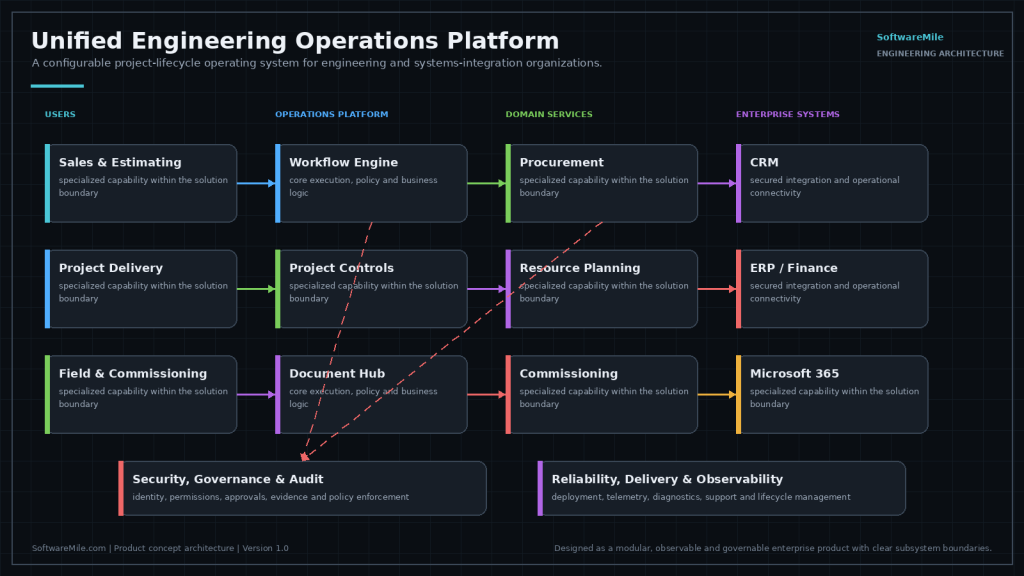
Engineering and systems-integration firms tend to run their projects across five or six systems that were never designed to meet: the estimate lives in a spreadsheet, the project plan in another tool, submittals in email, procurement in the accounting system, and commissioning in whatever the field team improvised. The work gets done, but nobody can answer simple questions — is this job profitable, what is actually outstanding, where did that decision come from?
Status: product concept, in active development. This is something we are building, not something you can buy today. We publish our roadmap because the engineering thinking behind it is the useful part — and because we would rather show you the design than imply a finished product.
Designed Capabilities
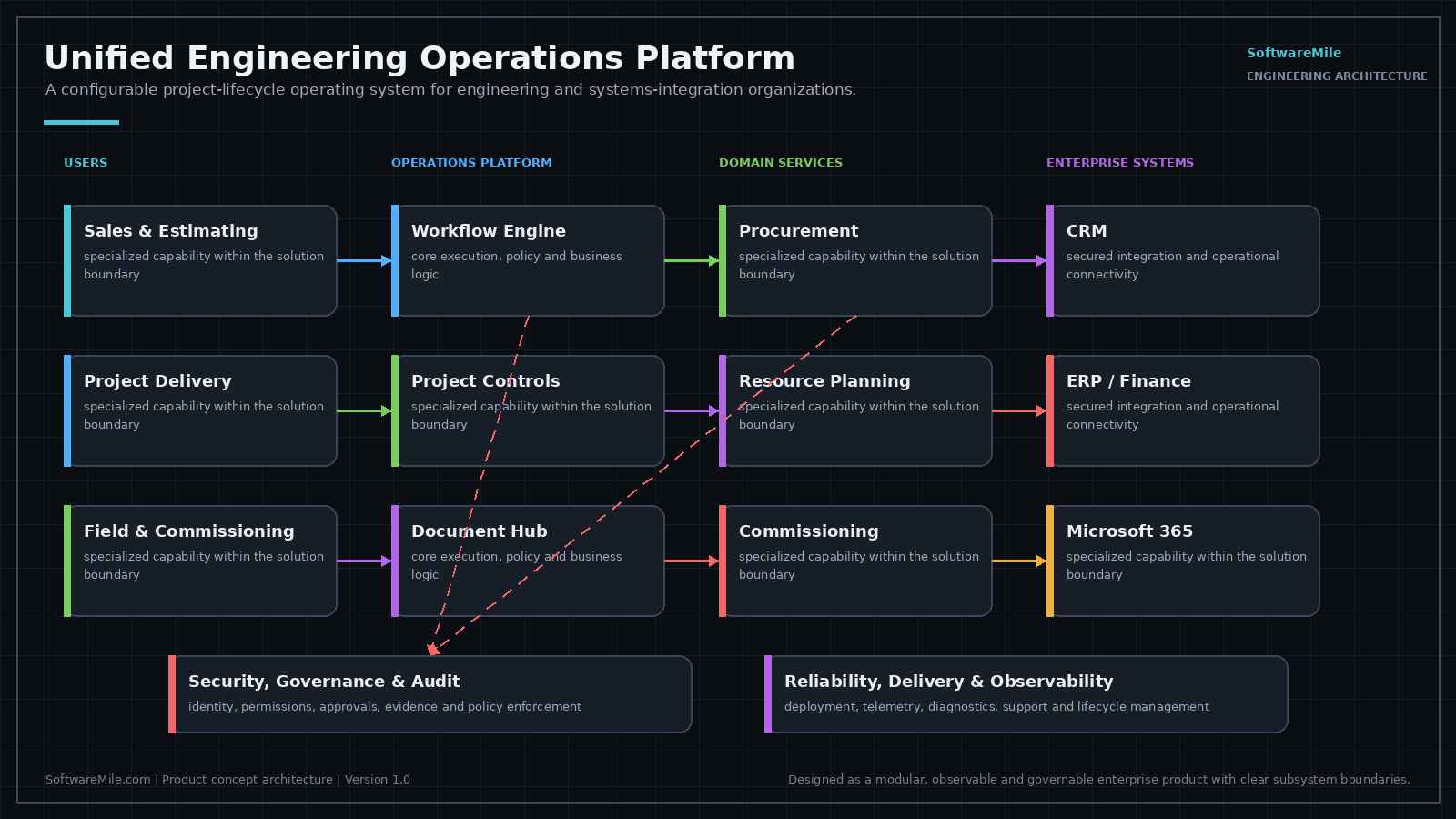
- Opportunity and scope intake — the job starts as structured scope rather than a forwarded email.
- Estimating and proposal control — estimates that stay connected to the project they become.
- Project planning and resource loading — schedule and people modelled together.
- Submittals, drawings and document control — versioned, with a record of who approved what.
- Equipment schedules and procurement — what was specified, what was ordered, what arrived.
- Commissioning and deficiency management — punch items tracked to closure with evidence.
- Project closeout and service transition — the handover that usually gets lost.
- Executive portfolio analytics — margin and risk across the whole book of work.
Why One Lifecycle Instead of Seven Tools
The value is not in any single module — comparable tools exist for each. It is in the continuity: an estimate that becomes a project that becomes a service agreement, without anyone re-keying it. That continuity is also what makes portfolio analytics trustworthy, because the numbers come from the work rather than from someone’s summary of it.
Tell us if this matches a problem you have — early input shapes what we build first, and we will give you an honest view of where it stands.
One Identity Per Job, and Why That Is the Hard Part
Continuity across a lifecycle is not achieved by wiring seven applications together. It requires that a job carry one identity from the first qualified inquiry through the last service call, and that every artifact produced along the way attach to that identity rather than to a folder, a spreadsheet tab, or a person's mailbox. Most of the engineering difficulty is not in the screens. It is in deciding what the durable object is and what is allowed to change about it.
The design treats each element of a job as a sequence of states rather than a record that gets overwritten. A device, an assembly or a labor line exists first as an assumption, then as an obligation, then as a physical object, then as something with an expiry date and a service owner. Stored as one field that gets updated, the history is gone and so is any ability to explain a variance without reconstructing it by hand. Stored as distinct states, the variance is computable and the question of who changed what stops being an argument.
The same structure has to serve readers who want different slices of it. A project manager works one job at a time and cares about what is open this week. A purchasing agent works across many jobs and cares about one stage of all of them. A service coordinator arrives years later and needs the device, not the project. Leadership reads the whole portfolio. Those are four different queries against one set of states, which is why the state model has to be settled before any screen is designed: a reporting layer added afterward can only summarize what the underlying records were shaped to answer.
- Assumed: a quantity, a model number and a labor hour that an estimator committed the company to before anyone could verify them.
- Committed: the obligation that exists once a vendor accepts a release, which is the moment the estimate stops being editable in any honest sense.
- Received: what physically showed up, in what condition, against which release, and where it was put.
- Accepted: the point at which a device has been demonstrated to work under the sequence it was sold for, with that demonstration recorded against the device itself.
- Warranted: the same device again, now carrying an owner, an expiry, and a service history that begins accumulating.
When a Single Tool Is the Better Answer
A lifecycle platform is the wrong choice when the pain is confined to one stage. If estimating is the bottleneck and everything downstream works, buy an estimating tool and keep the exports. Replacing a stack that functions carries a cost that never appears on a license line: the period during which nobody fully trusts either system.
The case for a single lifecycle strengthens as a function of two things, how often the same fact has to be re-entered by a different person, and how much of the company's margin sits in the gaps between stages. A firm doing repeatable work on a short chain of quote, install, invoice has small gaps. A firm doing multi-year integration work, where a device specified early is commissioned long afterward and then serviced for years by people who were not on the install, has large ones. Those gaps are where the questions above become unanswerable.
Headcount matters less than lifecycle length and handoff count. Two firms of identical size can have entirely different needs here: one where the estimator, the project manager and the service coordinator sit in one room and talk daily, and one where those roles are in different offices and communicate only through documents. The second has a continuity problem the first does not, and buying software for the first will mostly add data entry.
One more distinction worth being blunt about. If the current systems are disliked but the data in them is accurate and reconcilable, that is a process and training problem wearing a software costume. Consolidating tools does not fix a workflow nobody follows, it just moves the non-compliance somewhere newer.
- The failure is inside one stage and the handoffs on either side of it are clean.
- Jobs are short enough that the person who quoted the work is still on it at closeout.
- The existing systems hold accurate data and the complaint is about how they look, not what they contain.
- No one internally has the authority to settle definitional questions about job structure, numbering and approvals.
What the Design Depends On From the Customer
A system of this shape depends on decisions only the customer can make, and those decisions are the substance of the work rather than configuration that would be sorted out during a rollout. Someone has to own the answer to what a job is: whether a change order is a new job or an amendment to an existing one, whether a multi-building campus is one project or several, whether a service agreement inherits from the install project or stands on its own. Different firms answer these differently, most of the answers are defensible, and none of them can be inferred by the software.
There is a data question that precedes any software at all. Equipment and part identifiers have to be consistent enough that the same device recognized at estimate, at purchase order and at acceptance is understood to be one device rather than three. Many firms carry three naming conventions, one per department, plus whatever the distributor prints on the packing slip. Reconciling those is unglamorous work that does not get easier by being postponed until after a system is chosen.
Approval authority has to be made explicit. Who can release a purchase, who can accept a substitution, who can declare a system complete: in most firms these are understood informally and enforced socially. Writing them down as rules exposes disagreements that were previously invisible, which is uncomfortable and is also a large part of the value. A platform that encodes an approval chain nobody actually agreed to will be routed around within a month.
The Failure Modes the Design Has To Survive
The most likely way a platform of this kind fails is that estimators route around it. If the estimating module cannot express how a particular firm actually prices work, including the judgment adjustments that never appear in any published labor unit, the estimate would get built in a spreadsheet and typed in afterward. Continuity would then be broken at the first step, and everything downstream would inherit a number nobody in the field believes. The design has to absorb estimating methods it did not anticipate rather than require firms to conform to one.
Field capture is the second exposure and it constrains the design more than anything else. Acceptance evidence gets created in mechanical rooms, on ladders, in buildings with no signal, by people whose priority is finishing before dark. Anything that takes more than a few seconds per device would not survive contact with that environment, and a lifecycle record with a hole in it at the acceptance stage is a record no one can rely on later. That points to offline capture, minimal required input, and reconciliation afterward rather than complete input at the moment.
The third is the migration boundary. Any firm adopting this would have in-flight jobs that are partly estimated, partly procured, and midway through commissioning. A cutover has to define which jobs start in the new system, which finish in the old one, and how a portfolio view spans both without being quietly wrong. Running in parallel for a period is usually the right call and is also the phase where duplicate entry costs people their patience, so the parallel window has to be bounded and its end condition agreed before anything is switched on.
Frequently Asked Questions
What is the Unified Engineering Operations Platform, concretely?
It is a single system of record for the full lifecycle of an engineering or integration job, where each stage writes to the same underlying job record instead of to its own separate database. It is not an accounting package and would not replace a general ledger. It is not a CAD or design authoring tool. It is also not a general-purpose project management application with construction labels applied to it, because a generic task tracker cannot represent a submittal revision or a procurement release as anything other than a task with a due date.
Can we buy it, license it, or run a pilot right now?
No. It is a product concept in active development, so there is nothing to license, install or pilot at this stage, and no release date has been set. What exists today is design work rather than software: the data model, the state handling described above, and the integration boundaries. Anything on this page describing installation or integration is how the system is intended to work, not a description of deployments.
What would it run on, and what has to already exist on our side?
It is designed as a web application on cloud infrastructure, with a browser client for office roles and a mobile client for field capture that functions without connectivity and syncs when a connection returns. The customer-side prerequisites are mostly organizational rather than technical: an accounting system that exposes an API or, at minimum, scheduled exports, an identity provider if single sign-on is wanted, and internal agreement on job and equipment numbering. Self-hosting for firms with contractual requirements is a design consideration, but it changes the operational model enough that it would be scoped separately.
How would a rollout actually proceed, in what order?
The intended sequence begins with the data decisions rather than the software: job definition, numbering, equipment identifiers and approval authority, because every stage downstream inherits them. Next, one live job would be run end to end in the platform while the existing systems keep running, so the model is tested against real work rather than sample data. After that, adoption would move one stage at a time across the portfolio, usually starting where the pain is worst, with the remaining stages continuing as they do now. New jobs would enter the platform first and in-flight jobs would finish where they started unless a specific job has a reason to move. That is an intended order, not a schedule.
How would it integrate with the accounting system we already run?
The design assumes accounting stays where it is. Cost codes, vendors, purchase orders and job cost actuals would move across a defined boundary, with the accounting system authoritative for anything touching the general ledger and the platform authoritative for scope, schedule, documents and field state. The direction of travel for each field has to be settled deliberately, because a two-way sync with no owner per field produces conflicts nobody can adjudicate afterward. How deep the integration can go depends on what the accounting product exposes: some publish a full API, others support only scheduled file exchange, and the second case means periodic reconciliation rather than live figures.
What happens to the tools our teams already use, like email, drawing systems and spreadsheets?
They do not disappear. Submittals arrive as email attachments and drawings live in the systems that produce them, so the design captures references and revision state instead of trying to become the authoring tool. Spreadsheets are expected to persist for estimating scratch work and one-off analysis, and the intent is to make import and export ordinary rather than to prohibit them. The part that should not stay in a mailbox is the sign-off and the reasoning behind a decision, because a thread is where the ability to reconstruct history goes to die.
Who holds the data, and what stays under our control?
Customer data belongs to the customer, including the ability to extract it in a documented, usable format at any time rather than through a support request. The design principle is that job history, cost data and equipment records must be exportable in full and readable without the platform, since a lifecycle record legible only inside one vendor's software recreates the lock-in problem it is supposed to solve. Access would be role scoped, so a field technician sees the devices and jobs assigned to them rather than the portfolio, and financial visibility is granted separately from operational visibility. Hosting arrangements, retention periods and any requirement for data residency would be settled per engagement.
What would we have to provide or decide before this could be useful to us?
One person with the authority to settle definitional questions, an accurate account of how work currently moves between roles, and the naming and numbering conventions the firm intends to standardize on. You would also have to decide how much history comes forward: open jobs and active service agreements usually justify migration, long-closed jobs usually do not. Nobody outside the firm can make those calls, and a system configured on guesses about them produces reports that are internally consistent and wrong.